Loading...
Join our Facebook Group: Join: Expats in Poland
Loading...
Everything you need to know about getting a karta pobytu in Poland. From your first temporary permit to permanent residence and beyond.
Polish karta pobytu - your residence card
A karta pobytu (literally "residence card") is a plastic ID-style card issued by Polish authorities that proves you are a legal resident of Poland. It's the document most non-EU foreigners eventually get after arriving on a work visa or other Type D visa. Think of it as the Polish equivalent of a green card, though the temporary version needs to be renewed.
The karta pobytu is more than just a residence permit - it doubles as your ID within Poland. You can use it instead of your passport at banks, at the post office, and when dealing with government offices. It contains your photo, PESEL number, and basic personal data, much like a Polish national ID card (dowod osobisty).
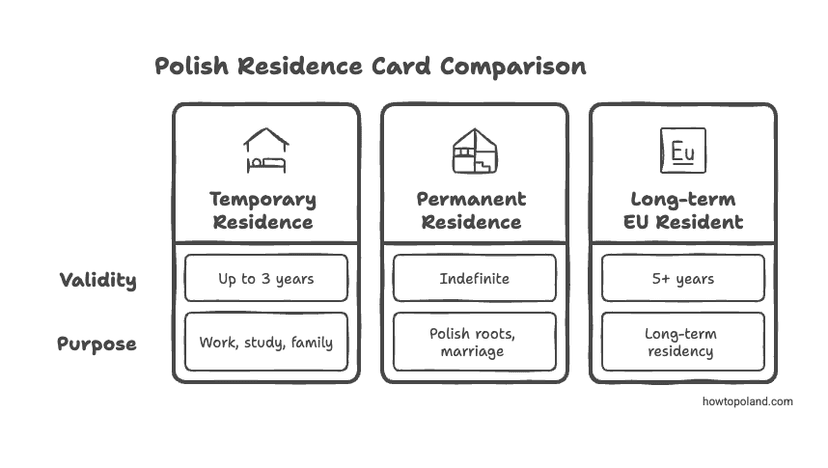
Poland issues three main types of residence permits: temporary (czasowy), permanent (staly), and EU long-term resident. Most foreigners start with a temporary permit and work their way up over the years. The system is straightforward on paper, though the wait times can test your patience.
Quick summary
Visa gets you into Poland → karta pobytu lets you stay long-term → works as your Polish ID → temporary (up to 3 years) or permanent (indefinite) → apply online through the MOS system.
Poland has three types of residence permits. Which one you qualify for depends on how long you've been in Poland and your situation.
Karta pobytu czasowego
This is the most common type - the one most foreigners get first. It's valid for up to 3 years (though it can be issued for shorter periods, like 1 year) and can be renewed as many times as you need. The temporary permit is always tied to a specific purpose: work, study, family reunification, business, or other grounds.
The most common subtypes are:
Karta pobytu staly
This is the "forever" permit. It doesn't expire (though the physical card is replaced every 10 years). With a permanent residence permit, you can live and work in Poland indefinitely, access social benefits, and eventually apply for Polish citizenship.
You can apply after 5 years of continuous legal residence in Poland on a temporary permit. Some people qualify sooner: spouses of Polish citizens after 3 years of marriage (and 2 years in Poland), holders of the Karta Polaka (Polish ancestry card) can apply immediately, and refugees after 5 years.
Requirements include a stable income, health insurance, Polish language skills at B1 level, and a clean criminal record. You also need to pass a test on Polish history and society.
Karta pobytu rezydenta dlugookresowego UE
Similar to the permanent residence permit, but with one major advantage: it lets you live and work in other EU countries, not just Poland. The requirements are the same as for permanent residence (5 years of continuous residence, language skills, stable income), but the income threshold is slightly higher - at least 1.5x the minimum wage.
Worth considering if you think you might relocate to another EU country down the line. Moving to Germany, France, or the Netherlands is significantly easier with this permit than starting from scratch.
Timing matters more than anything else with your karta pobytu application. The rule is simple: you must submit your application before your current legal basis for staying in Poland expires. On a Type D visa? Apply before the visa expires. Renewing a temporary permit? Apply before the current one runs out.
If you entered Poland on a work visaor other Type D visa, we recommend applying for your karta pobytu 2-3 months before your visa expires. Don't wait until the last week. The reason: gathering all the required documents takes time, and you need to prepare proper digital scans of everything for the electronic application through MOS.
Technically, you can submit your application on the very last day of your visa and still be legal. But this is risky - if your documents are incomplete or your application has errors, you could face complications that put your legal stay at risk.
If you already have a temporary karta pobytu and need to renew it, you must submit your renewal application no later than the last day of your current permit's validity. However, the recommended deadline is at least 45 days before expiry to give yourself a comfortable buffer.
If you submit on time (before your visa or current permit expires), you'll receive a stamp in your passport that legalizes your stay while the application is being processed. This stamp is crucial - it means you can legally live and work in Poland even if the processing takes months. Without it, you're in the country illegally.
Warning: If you let your visa or permit expire before submitting the karta pobytu application, you lose the right to the stamp. You may need to leave Poland and start over with a new visa. Don't risk this.
What you need depends on the type of permit and purpose of your stay. Below are the requirements for the most common scenario - a temporary residence and work permit (jednolite zezwolenie). Other permit types have additional or different requirements.
Tip: Prepare digital scans of all your documents before starting your MOS application. Documents must be uploaded as clear, legible scans or photos. You will also need to bring originals when summoned to the Voivodeship Office for in-person verification, so keep everything organized.
Need help with your application?
Get matched for free with a verified, English-speaking immigration specialist in your city.
New from April 27, 2026: Residence permit applications (temporary, permanent, and EU long-term) must now be submitted electronically through the MOS system (Modul Obslugi Spraw) at mos.cudzoziemcy.gov.pl. Paper applications and in-person submissions at the Voivodeship Office are no longer accepted. You will still need to visit the office in person when summoned by the voivode for document verification, fingerprints, and a signature sample.
The entire application process now happens online through MOS. Here's how it works:
Go to mos.cudzoziemcy.gov.pl and create an account. You log in through login.gov.plusing a profil zaufany (trusted profile) or a qualified electronic signature. If you don't have a profil zaufany yet, you can set one up online through your Polish bank (most major banks support this) or in person at a government office.
Complete the electronic application form in MOS and upload scans of all required documents (see the list above). The most common reason applications are delayed is missing paperwork. Make sure your employer has filled out "Zalacznik nr 1" correctly - mistakes in this form are extremely common and cause delays. If any documents are not in Polish, have them translated by a sworn translator (tlumacz przysiegly) and upload the translations as well.
Once you've completed the form and attached all documents, sign the application electronically using your profil zaufany (trusted profile), podpis osobisty (personal signature via e-ID), or kwalifikowany podpis elektroniczny (qualified electronic signature). Submit through the system. The date of electronic submission counts as your official application date - this is what matters for maintaining your legal stay.
After your application is registered, you will be summoned to the Voivodeship Office (Urzad Wojewodzki) for an in-person visit. At this appointment, you will present the original documents for verification, have your fingerprints taken, and provide a signature sample. You will also receive the stamp in your passport (the "stempel") confirming that your application has been accepted - this stamp is your proof of legal stay while the application is processed.
This is the hard part. Processing times vary from 1 month to over 12 months depending on the city and the complexity of your case. You can check the status of your application through the MOS system using your case number. During this time, the stamp in your passport keeps your stay legal. See the processing times section below for details.
Once your application is approved, you will receive a decision letter (decyzja). After the decision becomes final (14 days after delivery, unless you or the authorities appeal), you pay the 50 PLN card issuance fee and wait for the physical card to be produced. This takes about 2-4 weeks. You then pick it up at the Voivodeship Office - you must go in person with your passport.
Getting a karta pobytu is cheap compared to most other countries:
| Fee | Amount | Notes |
|---|---|---|
| Temporary residence permit | 340 PLN | Stamp duty (oplata skarbowa) |
| Temporary residence + work permit | 440 PLN | 340 PLN + 100 PLN for work authorization |
| Permanent residence permit | 640 PLN | Stamp duty |
| EU long-term resident permit | 640 PLN | Stamp duty |
| Card issuance (all types) | 50 PLN | For producing the physical card |
| Sworn translations | 30-60 PLN/page | If your documents need translation |
| Passport photos | 30-50 PLN | 4 biometric photos at a photo booth |
Total cost for a first-time temporary residence and work permit: approximately 500-600 PLN (about 115-140 EUR), including the card, photos, and a few translations. This is significantly cheaper than comparable permits in Germany, the UK, or the Netherlands.
The legal deadline for processing a temporary residence permit is 1-2 months. In practice, it takes much longer, especially in major cities. Realistic processing times based on recent reports:
| City (Voivodeship) | Temporary permit | Permanent permit |
|---|---|---|
| Warsaw (Mazowieckie) | 4-12 months | 6-18 months |
| Krakow (Malopolskie) | 3-8 months | 4-10 months |
| Wroclaw (Dolnoslaskie) | 2-6 months | 4-8 months |
| Gdansk (Pomorskie) | 2-5 months | 3-7 months |
| Poznan (Wielkopolskie) | 2-5 months | 3-7 months |
| Smaller voivodeships | 1-3 months | 2-5 months |
Warsaw is notoriously the slowest. The Mazowiecki Voivodeship Office handles over 100,000 applications per year and is chronically understaffed. If you live in Warsaw and your application is taking 6+ months, that's unfortunately normal.
You can file a formal complaint ("ponaglenie") if the legal deadline has passed - this sometimes speeds things up. In extreme cases, people hire specialized immigration firmsto push the process forward, though it's not always necessary.
After your electronic application is registered, you'll be summoned to the Voivodeship Office for an in-person visit. During this visit, you receive a stamp (stempel) in your passport. This stamp is extremely important - it's your legal proof of stay while the application is being processed. Here's what you need to know:
Practical advice: If you know you will need to travel abroad while waiting for your karta pobytu, plan ahead. Some people apply for a short Schengen visa at another country's consulate, or arrange their travel before submitting the karta pobytu application (while their original visa is still valid).
Your rights depend on which type of karta pobytu you hold:
| Right | Temporary | Permanent | EU Long-term |
|---|---|---|---|
| Live in Poland | Up to 3 years | Indefinite | Indefinite |
| Work freely (any employer) | Only if permit allows | Yes | Yes |
| Travel in Schengen (90/180 days) | Yes | Yes | Yes |
| Live/work in other EU countries | No | No | Yes |
| Access to social benefits | Limited | Full | Full |
| Vote in local elections | No | Yes | Yes |
| Path to citizenship | Via permanent first | After 3 years | After 3 years |
| Protection from deportation | Standard | Strong | Strong |
All karta pobytu holders have access to the Polish healthcare system (through ZUS/NFZ if employed), can open bank accounts, sign contracts, and access public services. Your karta pobytu serves as a valid ID document within Poland, so you don't need to carry your passport for daily activities.
Temporary residence permits need to be renewed before they expire. The renewal process is almost identical to the original application - you submit the same documents through the MOS system, pay the same fee, and wait for processing. Think of it as applying again from scratch rather than simply extending the existing permit.
These don't expire, so no renewal needed. The physical card does need to be replaced every 10 years (just the card, not the permit itself) - you bring a new photo, pay 50 PLN, and get a new card.
Most foreigners aim to eventually upgrade from a temporary to a permanent residence permit. There are several paths:
Live in Poland continuously for 5 years on temporary residence permits. "Continuous" means you did not leave Poland for more than 6 months at a time, and your total absences did not exceed 10 months over the 5-year period. You also need: stable regular income, health insurance, Polish language certificate (B1 level), knowledge of Polish history and society, and a clean criminal record.
If you hold an EU Blue Card, you can apply for an EU long-term resident permit after just 2 years in Poland (or 5 years total across EU countries with the last 2 in Poland). This is one of the biggest advantages of the Blue Card. Use our salary calculator to check if your salary qualifies for the Blue Card threshold.
If you are married to a Polish citizen for at least 3 years and have lived in Poland for at least 2 years on a temporary permit, you can apply for permanent residence. This path does not require the Polish language test, though language skills are still assessed informally.
If you hold a Karta Polaka (a document confirming Polish ancestry or connection to Polish culture), you can apply for permanent residence immediately upon settling in Poland. This is the fastest path available. See our citizenship by descent guide for related information.
After obtaining permanent residence, you can apply for Polish citizenship by naturalization after 3 years. Citizenship gives you the right to vote in national elections, hold a Polish (EU) passport, and eliminates the need for any further permits.
If your circumstances change significantly, you may need to apply for a new permit with a different purpose. The most common scenarios:
In all these cases, you submit a new application through the MOS system. Your old permit remains valid until the new one is decided, as long as you applied on time. The good news is that the time spent on your previous permit counts toward the 5-year continuous residence requirement for permanent residence.
Yes, if you applied for a residence and work permit and have the stamp in your passport, you can continue working for the employer specified in your application. This right lasts for the entire processing period, even if it takes months.
Warsaw (Mazowieckie Voivodeship) is the slowest in Poland. For a temporary residence permit, expect 4-12 months. For permanent residence, 6-18 months. These are realistic timelines as of 2026. You can file a formal complaint (ponaglenie) if the legal deadline has passed, which sometimes helps speed things up.
Yes. With a valid karta pobytu (the physical card, not just the stamp), you can travel to other Schengen countries for up to 90 days within any 180-day period. You need both your passport and karta pobytu when crossing borders. The EU long-term resident permit additionally allows you to reside and work in other EU countries.
For a temporary residence permit, no Polish language skills are required. For permanent residence and the EU long-term resident permit, you need a B1 certificate in Polish (or A2 for the EU long-term permit, depending on the specific path). The certificate is issued by the State Commission for the Certification of Proficiency in Polish as a Foreign Language.
You have 14 days from receiving the negative decision to file an appeal (odwolanie) to the Head of the Office for Foreigners (Szef Urzedu do Spraw Cudzoziemcow). If the appeal is also rejected, you can take the case to the administrative court (Wojewodzki Sad Administracyjny). During the appeal process, you can remain in Poland legally. A specialized immigration firm is highly recommended for appeals.
It's complicated. If you applied for a residence and work permit for Employer A and switch to Employer B while it's pending, you need to notify the Voivodeship Office and update your application. The office will need new documents from Employer B (Zalacznik nr 1, employment contract). In practice, this often resets the processing clock. If possible, try to stay with your current employer until the decision is made.
Yes. Your spouse and children under 18 can apply for their own temporary residence permits based on family reunification. They first need to enter Poland (usually on a family reunion visa), then apply for their own karta pobytu through the MOS system (mos.cudzoziemcy.gov.pl). Your spouse will receive a work authorization as part of their residence permit.
Report the loss to the Voivodeship Office within 3 days. You will receive a temporary certificate confirming your residence status, and a new card will be produced (50 PLN fee). Until you get the replacement, carry the certificate and your passport. If the card was stolen, also file a police report.
Get matched for free with a verified, English-speaking specialist in your city.
Verified specialists only
We only recommend licensed adwokat and radca prawny registered with the Polish Bar
English-speaking
All partners are fluent in English and experienced with foreign clients
Free matching service
No cost to you - we connect you directly with the right specialist for your case
Immigration specialists
Our partners focus exclusively on immigration law - not generalists