
Loading...
Join our Facebook Group: Join: Expats in Poland
Loading...
The reality is that getting a loan in Poland as a foreigner has become much more accessible than most expats realize. This comprehensive guide will walk you through the entire process, from choosing the right lender to receiving your funds, with practical tips and real-world advice.
The reality is that getting a loan in Poland as a foreigner has become much more accessible than most expats realize. What's changed isn't just the number of lenders willing to work with foreigners, but their understanding of expat situations - irregular income patterns, lack of Polish credit history, and different employment arrangements that were once automatic rejections.
The Polish lending market now includes specialized online platforms that evaluate applications differently than traditional banks. Instead of focusing solely on employment contracts, many lenders look at actual money flow in your account, making the process more realistic for freelancers, remote workers, and people with non-traditional income sources. If you're self-employed, our guide to starting a business in Poland covers the tax forms and registration that lenders may ask about.
What separates successful applications from rejections usually comes down to preparation and choosing the right type of lender for your specific situation rather than applying everywhere and hoping something sticks. Before you start applying for loans, make sure you have a solid banking foundation - check our bank accounts comparison to find the right bank, or read the step-by-step guide to opening a bank account in Poland if you don't have one yet.
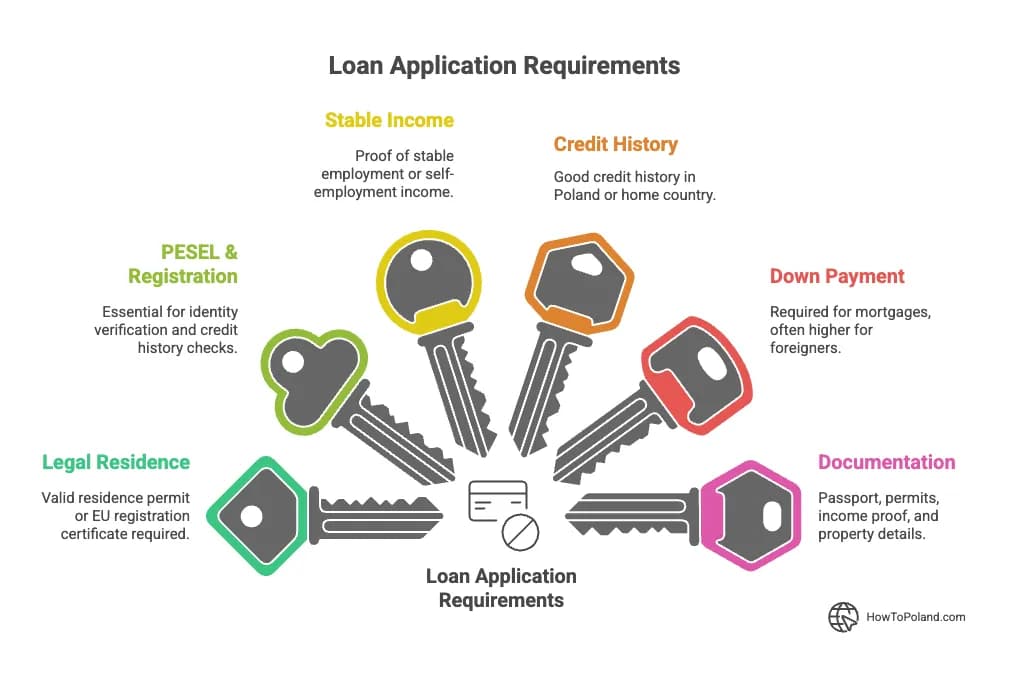
Getting a loan in Poland is easier than you think
These lenders have proven track records with foreign applicants and offer the best combination of approval rates, speed, and terms.

Foreigners with Revolut account seeking quick loans

Foreigners seeking quick 1-month cash with easy approval

All foreigners with stable income
Despite what many sites claim, "stable income" doesn't necessarily mean a traditional employment contract. Many lenders now accept freelance payments, foreign transfers, or mixed income sources - as long as money regularly appears in your Polish account. Not sure how much of your salary actually lands in your account after taxes? Use our gross to net salary calculator to see your real take-home pay after ZUS and PIT deductions.
Must-haves:
The application process that actually works. Follow these steps to maximize your chances of approval.
| Step | What You're Actually Doing | Time Needed | Documents Required | Reality Check |
|---|---|---|---|---|
| Research | Compare 3-4 lenders based on your profile | 15-30 minutes | None | Don't waste time on lenders that don't accept your employment type |
| Application | Complete online form in one session | 10-20 minutes | ID, PESEL, bank details | Incomplete applications often expire - finish in one go |
| Verification | Bank account and identity checks | 5 minutes - 2 hours | Bank login or statements | Most rejections happen here if your account looks messy |
| Assessment | Automated credit scoring + manual review | 30 minutes - 3 days | Income proof (sometimes) | Online lenders are faster but traditional banks offer better rates |
| Funding | Money transferred to your account | Instant - 24 hours | None | Weekends and holidays delay transfers |
Compare 3-4 lenders based on your profile. Don't waste time on lenders that don't accept your employment type.
Gather all required documents before starting the application. Having everything ready speeds up the process significantly.
Fill out the online application form in one session. Incomplete applications often expire - finish in one go.
The lender will verify your bank account and identity. Most rejections happen here if your account looks messy.
The lender will assess your application using automated credit scoring and manual review.
Once approved, funds will be transferred to your account. Weekends and holidays may delay transfers.
Try online lenders first - they're more flexible about credit history requirements. Some even view lack of Polish debt positively.
If you're freelancing or working remotely, bank statements showing consistent incoming transfers often work better than trying to explain complex employment arrangements.
Several major lenders now offer English customer service. If the website is only in Polish, their customer support usually isn't - call and ask.
Your PESEL needs to be active in the government system before lenders can verify it. If you just received it, wait 2-3 weeks before applying. Learn how to get your PESEL number in our dedicated guide.
The key insight most guides miss is that loan approval in Poland isn't just about meeting requirements - it's about matching your profile to the right type of lender and presenting your financial situation in the clearest possible way.
Most Polish loan providers offer their services primarily in Polish. Use your browser's translation feature to navigate in English. If certain functions don't work in the translated version, switch back to Polish. Many providers offer English-speaking customer service through dedicated phone lines or online chat support.
Yes, many Polish lenders now offer loans to foreigners. Online fintech companies like Revolut and specialized platforms like Wandoo are often more flexible with foreign applicants than traditional banks. You'll need a valid ID, PESEL number, Polish bank account, and proof of residence in Poland.
You'll typically need a valid passport or EU ID card, PESEL number (active for at least 2 weeks), Polish bank account with 2-3 months of transaction history, and proof of residence in Poland such as a residence card, rental agreement, or utility bill. Some lenders also require income documentation like employment contracts or bank statements.
Approval times vary by lender. Online platforms like Vivigo can approve in 5 minutes, Wandoo takes about 15 minutes, and Revolut processes in 5-15 minutes. Traditional banks like Alior Bank may take 1-3 business days. The fastest approvals come from online lenders that use account analysis rather than traditional credit checks.
Not necessarily. Many online lenders evaluate applications based on your actual bank account activity rather than traditional BIK credit history. Some lenders even view the lack of Polish debt positively. However, traditional banks usually check BIK and may require established credit history in Poland.
Yes, many lenders now accept non-traditional income sources. Online lenders often analyze your bank account activity rather than requiring employment contracts. If you have consistent income flow in your Polish account from freelance work or remote employment, you have good chances of approval with platforms like Revolut or Wandoo.
Don't apply to multiple lenders at once as it may affect your BIK credit score. Wait 2-3 weeks, clean up your bank account history (cover overdrafts), and try a different type of lender. If traditional banks rejected you, try online platforms which are more flexible for foreigners.
RRSO (Rzeczywista Roczna Stopa Oprocentowania) is the Annual Percentage Rate of Charge - the total yearly cost of a loan including all fees, not just the interest rate. Polish law requires all lenders to display RRSO clearly. Always compare RRSO rather than just interest rates, as some lenders may have low interest but high processing fees.
Yes, but mortgages have stricter requirements than personal loans. You'll need a PESEL number, stable income (usually a permanent employment contract in Poland), minimum 20% down payment, and some Polish credit history. Banks like PKO, mBank, and Alior Bank offer mortgages to foreigners. The process takes 4-8 weeks on average.
Yes, as long as you use licensed lenders. All legitimate lenders in Poland are registered with the Polish Financial Supervision Authority (KNF) and must comply with Polish consumer credit law, which caps interest rates and non-interest costs. Check the KNF register before borrowing. Avoid any lender that asks for upfront fees before disbursing the loan.
Compare all loan providers side-by-side with rates, requirements, and approval times.
A Polish bank account is required for loan applications. Find the best one for your needs.
Need flexible credit instead of a fixed loan? Compare Polish credit cards for expats.
PESEL is required for most loan applications. Learn how to get yours quickly.
Calculate your real take-home pay to know how much you can afford to borrow.
Understand Polish tax brackets - lenders check your net income for eligibility.
Choose from our top-ranked loan providers and get the funds you need. Compare rates, read requirements, and find the perfect loan for your situation.