Loading...
Join our Facebook Group: Join: Expats in Poland
Loading...
A step-by-step guide to opening a Polish bank account as a foreigner in 2026. Compare banks, see what documents you need (EU vs non-EU), learn how to open an account online without visiting a branch, and avoid the most common mistakes.
This table compares the account opening process across the most popular banks for foreigners in Poland. Requirements differ for EU and non-EU citizens.
| Bank | Online | English | No PESEL | EU Citizens Need | Non-EU Citizens Need | Time to Open | Monthly Fee | |
|---|---|---|---|---|---|---|---|---|
 mBank mBank | Passport only | Passport + visa/residence card | 15 min online | 0 PLN | Open Account | |||
 PKO BP PKO BP | Passport + address proof | Passport + residence card | 30-45 min in branch | 0 PLN | Open Account | |||
 BNP Paribas BNP Paribas | Passport + address proof | Passport + visa + employment | 30-60 min in branch | 0-2.5 PLN | Open Account | |||
 VeloBank VeloBank | Passport only | Passport + residence card | 20 min online | 0 PLN | Open Account | |||
 Millennium Millennium | Passport + PESEL | Passport + PESEL + residence card | 45-60 min in branch | 0-25 PLN | Open Account | |||
 Revolut Revolut | Passport only | Passport only | 5 min in app | 0 PLN | Open Account |
Last updated: May 2026. Requirements may vary - always confirm directly with the bank before visiting.
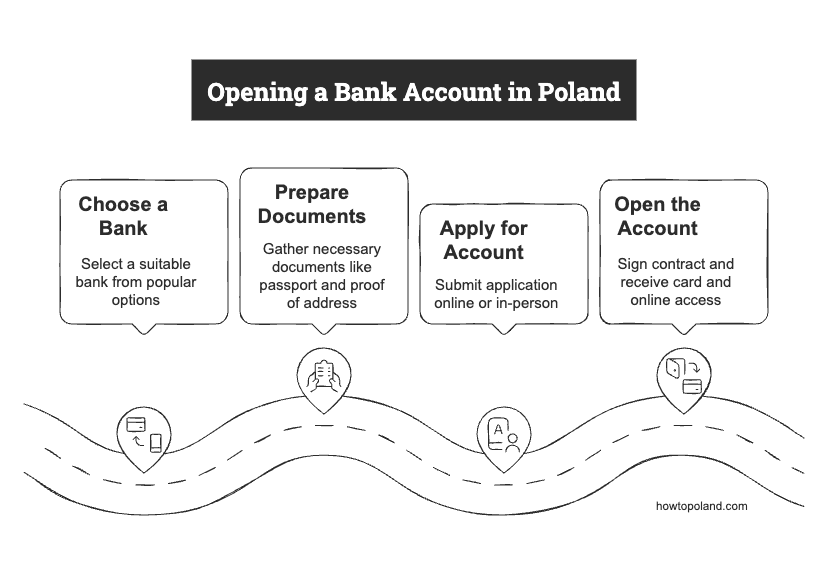
There are two ways to open a bank account in Poland: online or at a branch. The process depends on your citizenship, the bank you choose, and whether you have a PESEL number. Here's how each path works.
Three banks let foreigners open accounts entirely online: mBank, VeloBank, and Revolut. You don't need to visit a branch at all.
At mBank, the whole process takes about 15 minutes. At Revolut, it's under 5 minutes. You can do this from abroad before arriving in Poland.
Traditional banks like PKO Bank Polski, BNP Paribas, and Millennium require a branch visit. The process is straightforward but takes longer.
Branch visits take 30-60 minutes. Avoid walk-ins - without an appointment you may wait for hours, and English-speaking staff may not be available.
The process differs based on your citizenship. EU/EEA citizens have it easier because their ID documents are recognized across the EU under freedom of movement rules.
In 2026, most banks no longer require a PESEL number to open a basic account. mBank, VeloBank, PKO Bank Polski, and BNP Paribas all accept foreigners without PESEL. You can add it later. Some banks like PKO can even help you apply for a PESEL during the same visit. Revolut doesn't need PESEL at all. Only Millennium still requires PESEL from the start.
What you need depends on the bank and your citizenship. Here's a complete list of documents Polish banks may ask for when opening an account.
Every bank requires at least one valid photo ID. Accepted documents include:
Documents must be originals - banks do not accept photocopies or scanned prints. Your passport must not be expired.
Most traditional banks require proof that you live in Poland. Digital banks like mBank and Revolut are more flexible. Accepted documents include:
If you just arrived and don't have any of these yet, some banks accept a hotel booking or temporary accommodation confirmation. Revolut and mBank don't require address proof for account opening.
Some banks may ask for additional documentation depending on your situation:
The account opening process in Poland varies depending on your citizenship. Here are specific tips for the largest expat communities.
Ukrainians are the largest group of foreigners in Poland, and banks are well-prepared to serve them. If you have temporary protection status (ochrona tymczasowa), you received a PESEL number with UKR designation when registering - this works at all banks. You can open accounts at mBank, PKO, BNP Paribas, and Millennium using your PESEL UKR and Ukrainian passport.
PKO Bank Polski and mBank have Ukrainian-language customer support lines. PKO's IKO app is also available in Ukrainian. If you're sending money back to Ukraine, Revolut offers free PLN-to-UAH transfers at real exchange rates, which is significantly cheaper than Western Union or traditional bank transfers (which can cost 30-60 PLN per transaction).
If you have a Diia (Дія) digital passport on your phone, some banks may accept it, but bring your physical passport as a backup. For those with a temporary residence card (karta pobytu) or a Polish refugee travel document, the process is the same as for other non-EU citizens.
American citizens face a unique challenge: FATCA (Foreign Account Tax Compliance Act). US law requires foreign banks to report accounts held by US citizens to the IRS. Most Polish banks comply with FATCA, but some smaller ones may refuse to open accounts for Americans to avoid the reporting burden.
mBank, PKO Bank Polski, and BNP Paribas all accept US citizens. During account opening, you'll need to provide your US Social Security Number (SSN) or Individual Taxpayer Identification Number (ITIN) and sign a W-9 or W-8BEN form. This is standard and doesn't affect your account usage.
For transferring money between the US and Poland, Wise offers the best USD-to-PLN exchange rates. Traditional SWIFT transfers from US banks can cost $25-45 per transaction plus unfavorable exchange rates. Revolut also works well if you already have a US Revolut account - you can hold both USD and PLN in the same app.
India is one of the fastest-growing source countries for expats in Poland, especially in IT. Indian citizens need a valid passport plus a visa or residence card to open an account. If you're on a work visa and don't have a residence card yet, mBank and Revolut are the easiest options since neither requires a karta pobytu.
For sending money to India, Wise offers INR transfers at the real mid-market rate, which is usually 3-5% better than what banks offer. Revolut also supports INR but with higher markup on weekends. Avoid using your Polish bank for direct transfers to India - the fees (30-50 PLN) and exchange rates are consistently worse than Wise or Revolut.
If you have a PAN card or Aadhaar-linked Indian bank account, you can use UPI-based apps like Google Pay India alongside your Polish banking apps. Just keep in mind that your Indian bank may require periodic KYC updates if you're abroad for extended periods.
EU citizens have the simplest process. Under EU freedom of movement, Polish banks cannot refuse you an account based on nationality. You only need your national ID card or passport - no visa, no residence card, no proof of employment. PESEL is not required at most banks.
If you already have a euro-denominated account in your home country, you might wonder whether you need a Polish account at all. The answer is yes: your salary will be in PLN, rent is paid in PLN, and BLIK (which you'll use daily) only works with Polish bank accounts. Keeping your home bank for euro savings and using mBank for daily life in PLN is the most practical setup.
SEPA transfers between your home bank and Polish bank are free or nearly free (max €0.20 at some banks), so moving money back and forth is painless. Some German banks (N26, DKB) work well in Poland for ATM withdrawals, but they won't give you BLIK or a Polish IBAN for salary payments.
Belarusian citizens with humanitarian visas or international protection can open accounts at most Polish banks. You'll need your passport and your visa or residence card. If you received a PESEL through the registration process, this simplifies things further. PKO and mBank both accept Belarusian documents without issues.
Sending money to Belarus is restricted due to EU sanctions on Belarusian banks. Direct bank transfers to most Belarusian banks are blocked. Some expats use cryptocurrency or informal channels, but be aware of legal risks. Wise and Revolut do not support BYN transfers. Check current sanctions lists before attempting any transfers.
Turkish citizens need a passport plus a valid visa or residence card. The process is the same as for other non-EU citizens. mBank and Revolut are the fastest options if you don't have a karta pobytu yet. For TRY-to-PLN transfers, Wise generally offers the best rates. The Turkish community in Poland is growing, particularly in Warsaw and Wroclaw, so banks in these cities are familiar with Turkish documents.
There are over 50 commercial banks in Poland, but only a handful are genuinely foreigner-friendly. We recommend three banks based on user feedback and our own testing. If you need a business account for freelancing or a company, see our dedicated guide.

Digital-first users and tech professionals
First-time expats and students

International professionals and digital nomads

Best for International Use
For most foreigners, the best setup is mBank as your primary Polish account (salary, bills, BLIK) plus Revolut for international transfers and travel. For a full comparison of all banks, see our bank accounts comparison.
Before deciding on a particular bank and account model, compare the fees carefully. Polish bank pricing varies significantly - some accounts are completely free while others charge 15 to 50 PLN per month. The good news is that most banks offer free accounts if you meet simple conditions like receiving a monthly salary transfer.
Many banks charge a monthly fee for their current accounts, which ranges between 5-15 PLN ($1.20-$3.60 / €1.10-€3.30) on average. Premium accounts can be significantly pricier, reaching up to 50 PLN ($12 / €11) monthly. However, this price is often offset by extensive additional services such as free international transfers, premium customer support, and comprehensive insurance packages. For expats who travel internationally frequently, investing in premium accounts can be highly worthwhile.
However, you can also find current accounts without monthly fees. mBank and Revolut offer completely free accounts without conditions. Many traditional banks require a minimum monthly deposit (typically 2,000-3,000 PLN / $480-$720 / €440-€660) for free account management.
SEPA transfers from private customers are free of charge at most banks within Poland and the EU. However, high fees may be charged for outgoing and incoming international transfers outside the SEPA zone. Suppose you often make or receive international transfers. In that case, you need a current account – for example, from mBank, Revolut, or Wise – that supports these services under favorable conditions.
Traditional banks may charge 20-50 PLN ($4.80-$12 / €4.40-€11) for international transfers, while digital banks like Revolut offer real exchange rates with minimal fees.
There can also be huge differences in the costs for cash withdrawals. Free ATM withdrawals are mainly offered by banks that have a nationwide network of branches or belong to an ATM network. PKO Bank Polski operates the largest ATM network with over 20,000 machines, while other banks typically charge 3-5 PLN ($0.70-$1.20 / €0.65-€1.10) for foreign ATM usage.
Digital banks typically offer free monthly allowances for cash withdrawals. mBank provides 5 free withdrawals monthly, while Revolut offers different limits based on your account tier. For all further withdrawals, rather moderate fees apply.
In addition to the conditions for cash withdrawals in Poland, you should also check the costs for foreign withdrawals. Neo-banks often offer particularly attractive conditions for international ATM usage.
Cards can also be a relevant cost factor for a current account. Debit cards are typically available free of charge or for a small monthly fee (5-10 PLN / $1.20-$2.40 / €1.10-€2.20). On the other hand, credit cards sometimes incur annual fees ranging from 50-200 PLN ($12-$48 / €11-€44) that do not always reflect the services provided by the cards.
mBank and Revolut offer free debit cards with excellent international acceptance, while traditional banks may charge for premium card features.
SEPA (Single Euro Payments Area) covers all EU countries and several others. Transfers within SEPA are standardized and usually free for private customers at Polish banks. This means sending money to or from Germany, France, Spain, etc. costs nothing at most banks. Transfers outside SEPA (e.g. to the US, India, or Turkey) can cost 20-50 PLN - for those, use Revolut or Wise instead.
If you're moving to Poland for the first time, banking here will feel different from what you're used to. Poland is one of the most advanced cashless economies in Europe. Contactless card payments work almost everywhere - from supermarkets and restaurants to street vendors and public transport. You rarely need cash.
BLIK is the payment system you'll use daily. It generates a 6-digit code in your banking app that you type at checkout or ATMs. Poles use BLIK for everything: paying in shops, splitting dinner bills, sending money to friends, and buying things online. Every major Polish bank supports it. Once you set up your account, activate BLIK immediately - you'll need it from day one.
Poland uses the Polish zloty (PLN), not the euro. Your salary, rent, and bills will all be in PLN. If you're coming from a eurozone country, don't rely on your home bank card - foreign exchange fees add up fast. A Polish bank account with a PLN debit card is essential. For converting EUR or USD to PLN, use Revolut or Wise for the best exchange rates.
Open your account before arriving. You can open an mBank or Revolut account from abroad and have a virtual card ready when you land. This lets you pay for a taxi from the airport, buy a SIM card, and handle first-day expenses without carrying large amounts of cash.
Your employer will need your bank details quickly. Polish companies pay salaries by bank transfer, usually on the 10th of each month. You'll need to provide your IBAN and SWIFT/BIC code to HR. Having your account ready before your first working day avoids delays in receiving your first paycheck.
Set up automatic payments for rent and utilities. Polish landlords expect monthly transfers (przelew) to their bank account. Utility companies (electricity, gas, internet) send invoices that you pay via bank transfer or set up as standing orders (zlecenie stale) in your banking app. This is all done digitally - no checks, no cash envelopes.
ATMs are everywhere but watch out for private ones. Use ATMs that belong to your bank's network (free withdrawals). Avoid standalone ATMs from Euronet or other private operators in tourist areas - they charge high fees and offer bad exchange rates. If an ATM asks whether to charge you in your "home currency" (Dynamic Currency Conversion), always choose PLN.
Useful Polish banking terms: przelew (transfer), wpłata (deposit), wypłata (withdrawal), rachunek (account/invoice), odsetki (interest), karta płatnicza (payment card), zlecenie stale (standing order), historia operacji (transaction history).
Disclosure: Some links on this page are affiliate links. We only recommend banks we have personally tested. Our affiliate partnerships do not influence our recommendations.
After helping hundreds of expats with banking in Poland, we see the same mistakes repeatedly. Here's how to avoid them.
Walk-ins at traditional banks often mean long waits, and not every branch has English-speaking staff available. Always book an appointment online or by phone, and specifically request an English-speaking advisor. At PKO and BNP Paribas, this can save you hours. Better yet, open your account online at mBank and skip the branch entirely.
Many expats delay opening a bank account because they don't have a PESEL number yet. In 2026, most banks no longer require PESEL upfront. mBank, VeloBank, PKO, and BNP Paribas all let you open an account without one. You can add your PESEL later. Revolut doesn't need it at all.
Revolut and Wise are excellent tools, but they don't replace a Polish bank account for everything. Some employers only transfer salaries to accounts with a Polish IBAN (PL prefix). ZUS contributions and tax refunds also require a traditional Polish account. Government offices, utility companies, and landlords often insist on a domestic bank transfer. Open a Polish bank account as your primary and use Revolut as a supplement.
Poland is one of the most advanced mobile banking markets in Europe. BLIK payments, instant transfers, and mobile authorizations are standard. If you choose a bank, immediately set up the mobile app and activate BLIK. You'll use it daily for everything from grocery shopping to splitting bills with friends.
Some banks advertise "0 PLN monthly fee" but charge for card maintenance, SMS notifications, or paper statements. At Millennium, the free account requires a minimum 1,000 PLN monthly inflow - otherwise you pay 10 PLN/month. Always read the full tariff table (tabela opłat i prowizji) before signing. mBank and Revolut are genuinely free with no hidden conditions.
Banks require original documents - no photocopies or scanned prints. Your passport must be valid (not expired), and proof of address should be recent (within 3 months). If your rental contract is only in Polish, that's fine. But if it's in another language, bring a sworn translation or choose a bank like mBank that accepts English documents.
Yes, some neo-banks like Revolut and Wise allow you to open an account without a Polish residence permit or proof of residence. Traditional banks like mBank also accept foreigners with just a passport for EU citizens, or passport plus visa for non-EU citizens.
You typically require a valid passport, residence permit or visa, proof of address, and employment or student status. EU citizens usually need only a passport and proof of Polish address. Non-EU citizens need a passport plus residence card or visa. Some banks like PKO can issue a PESEL for you during the same visit.
PESEL is Poland's personal identification number system. In 2026, most banks no longer require PESEL upfront to open a basic bank account. You can open an account without PESEL at mBank, PKO, BNP Paribas, VeloBank and others, then add your PESEL later. Only some advanced products like mortgages require PESEL from the start.
Yes, several banks offer completely free accounts. mBank, VeloBank, and PKO Bank Polski offer 0 PLN monthly fee accounts with no conditions. Revolut also offers a free basic account. Traditional banks like BNP Paribas may waive fees if you meet minimum monthly deposit requirements.
Yes. Banks offer freelancers and self-employed business accounts tailored to their needs. Fintech and neo-banks like mBank and Revolut are especially popular with freelancers thanks to excellent digital features for accounting and tax management. Polish law doesn't require separate business accounts for sole proprietors (JDG).
Online accounts at mBank or VeloBank can be opened in 15-20 minutes. Branch visits at traditional banks like PKO or BNP Paribas take 30-60 minutes. Revolut accounts can be opened in about 5 minutes through their app. Your debit card arrives within 5-7 business days, but many banks offer instant virtual cards.
No. mBank offers complete English support including app, website, and customer service. Revolut is fully international. PKO Bank Polski provides English customer service hotlines. BNP Paribas has English-speaking staff in major city branches. VeloBank also offers English phone support.
Yes, digital banks like mBank and Revolut allow you to start the account opening process online from abroad. mBank offers video verification, so you can complete the entire process remotely. However, traditional banks typically require an in-person branch visit. Having an account ready before arrival makes the transition much smoother.
BLIK is Poland's national mobile payment system used by over 15 million people. It lets you pay in shops, online, and at ATMs using a 6-digit code generated in your banking app. All major Polish banks support BLIK. It's widely accepted across Poland and is often the preferred payment method for online purchases. Setting up BLIK is free and automatic with your bank account.
Yes. Polish bank accounts come with IBAN numbers that work for both domestic and international transfers. SEPA transfers from EU countries are typically free or very low cost. For non-EU transfers, consider using Wise or Revolut for better exchange rates. mBank also offers free incoming EU transfers.
Your Polish bank account remains active even if you move abroad. You can continue to use online banking, make transfers, and manage your account remotely. However, some banks may require periodic verification of your address or residency status. It's advisable to inform your bank about your move and update your contact details.
Start with our top recommended banks for foreigners. Both offer excellent English support and easy account opening processes.