
Loading...
Join our Facebook Group: Join: Expats in Poland
Loading...
Looking for a bank account in Poland as a foreigner? In 2026, you can open most Polish accounts online without a PESEL number, with full English support and 0 PLN monthly fees. This guide compares the best banks for expats - Millennium, ING, mBank, PKO and more - covering fees, English support, the documents you need, and how to open an account before your PESEL is issued.
In 2026, you no longer need a PESEL number to open a bank account in Poland. Major banks including mBank, PKO Bank Polski, BNP Paribas, VeloBank and Millennium now accept foreigners with just a passport (EU citizens) or passport + residence card/visa (non-EU). PESEL can be added later, often during the same branch visit, or applied for separately at your local urzad gminy.
Need a step-by-step walkthrough of the documents and process? Read our full guide on how to open a bank account in Poland as a foreigner. Already earning interest? Compare the top savings accounts in Poland too.

Digital-first users and tech professionals

Digital-first users and tech professionals
First-time expats and students
First-time expats and students

International professionals and digital banking users

International professionals and digital banking users
Digital banking users and cashback seekers
Digital banking users and cashback seekers

High-net-worth individuals and business owners

High-net-worth individuals and business owners

Polish speakers seeking loans and mortgages

Polish speakers seeking loans and mortgages

Business banking and traditional banking preferences

Business banking and traditional banking preferences
High-income professionals and international clients
High-income professionals and international clients

Cost-conscious users seeking basic banking

Cost-conscious users seeking basic banking
Most Polish banks offer their websites primarily in Polish. Use your browser's translation feature to navigate in English. If certain functions don't work in the translated version, switch back to Polish. Many banks provide English-speaking customer service through dedicated phone lines or at branches in major cities like Warsaw, Krakow, and Gdansk.
We are independent from the providers of the financial products that we test and evaluate.
We are transparent regarding our research processes and evaluation methods.
Our content undergoes careful quality check to ensure that it is well-researched, factually correct, and understandable.
We have extensive experience with financial products and understand what expats in Poland want and need.
When selecting a Polish bank account, it's crucial to consider factors such as language support, accessibility, fees, and banking preferences. Recently, the Polish banking market has witnessed significant digital transformation, with many banks offering innovative features like user-friendly mobile apps, competitive fee structures, and English-language support. However, traditional banks remain popular among locals and expats alike due to their extensive branch networks and established reputation.
Having a Polish bank account is essential for various purposes, including employment, renting accommodation, and setting up utilities. A local bank account is required to receive your salary, pay rent, and manage day-to-day expenses. Before signing a job offer it's worth checking exactly how much will land in that account each month - use our Poland gross to net salary calculator to see your real take-home pay after ZUS, PIT and NFZ deductions. In the following sections, we'll delve deeper into the factors you should consider when choosing a Polish bank account.
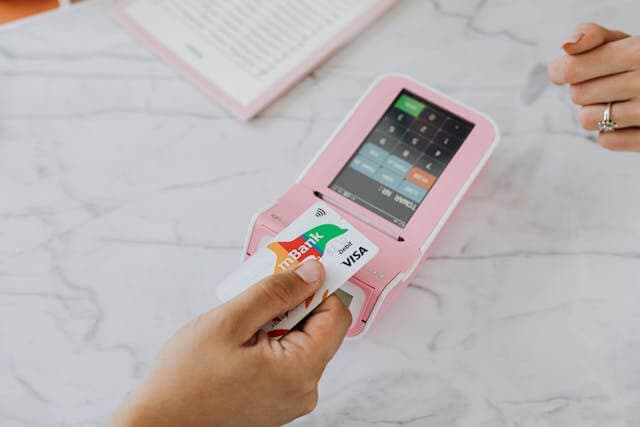
Digital banking solutions for foreigners living in Poland.
Photo: Kaboompics.com / Pexels
Polish employers pay salaries only to Polish IBAN accounts. You also need one for rent, utilities, ZUS contributions and tax refunds. Wise or Revolut won't work for these. Before signing a job offer, check your take-home pay with our gross-to-net salary calculator.
Card and contactless payments are accepted almost everywhere, including taxis and corner shops. The contactless PIN-free limit is 100 PLN. Cash is still handy for farmers' markets, tips, and some traditional restaurants outside city centres.
Always choose PLN (the local currency) when an ATM asks "convert to your home currency?" Saying yes triggers Dynamic Currency Conversion (DCC), which adds a 3-7% markup. Euronet ATMs are the worst offenders - use your bank's own ATMs or withdraw with BLIK instead.
BLIK is Poland's instant-payment system used by 15+ million people. It generates a 6-digit code in your banking app for in-store, online and ATM payments - no card needed. Activate it the day you get your account; many Polish online shops and services prefer BLIK over cards.
Planning to apply for a credit card too? See our guide to the best credit cards in Poland for foreigners - several options come with 0 PLN annual fee and English-language applications.
In 2026 most Polish banks no longer require a PESEL number upfront - EU citizens need just a passport, while non-EU citizens need a passport plus residence card or visa. Digital banks like mBank let you open an account entirely online in about 15 minutes with video verification. Traditional banks like PKO Bank Polski require a branch visit but can issue your PESEL during the same appointment.
Need the full step-by-step walkthrough?
Our dedicated guide covers every document, the branch vs online process, what to do if you're rejected, and tips for getting your card faster.
Read the full account-opening guide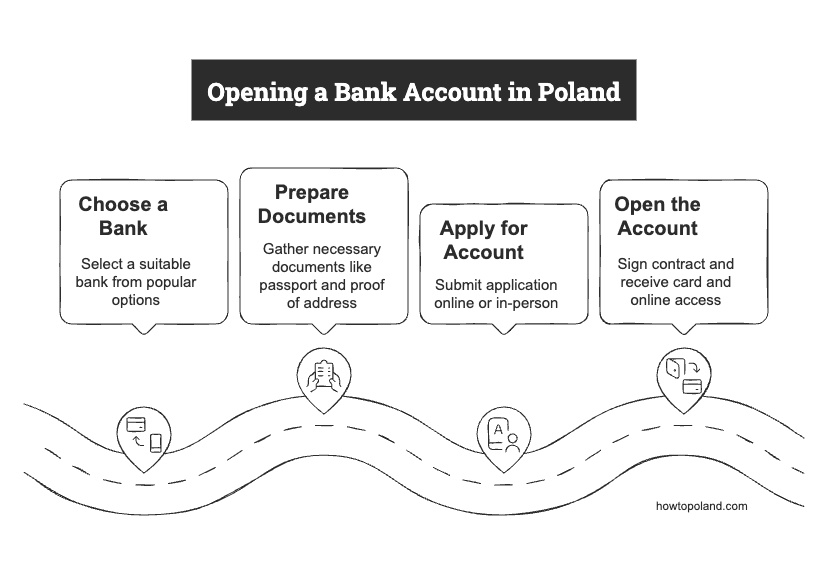
Complete guide to banking procedures for expats in Poland.
Infographic: How to Poland Guide
Requirements differ depending on your citizenship. Here is what each group needs to bring to a branch (or upload online).
Tip: Bring original documents, not photocopies. If opening online at mBank, have your passport ready for the video verification call. For the full step-by-step process, see our account-opening guide.
These are the most expensive and frustrating errors we see expats make with Polish banking. Avoid them and you'll save hundreds of zloty a year.
When an ATM offers to "convert to your home currency", always decline and choose PLN. Dynamic Currency Conversion adds a 3-7% markup. This applies to card terminals in shops too.
Airport currency exchanges (kantors) charge 5-15% spreads. Use your bank's app or a city-centre kantor instead. Online kantors like Cinkciarz offer rates close to mid-market.
Euronet (bright yellow ATMs) charges high fees and aggressively pushes DCC. Stick to ATMs branded with your bank's logo or withdraw cash for free using BLIK at any ATM.
Polish banks may block your card abroad if you don't set a travel notification first. Do this in your banking app before every trip, even for weekend hops to Berlin or Prague.
Many Polish online stores, food delivery apps and even vending machines only accept BLIK. Activate it in your banking app on day one so you're never caught without a payment method.
If you move flats, update your address with the bank immediately. PIN codes, new cards and official correspondence go to your registered address. An outdated address can also delay PESEL registration.
In addition to the online and traditional banks mentioned above, there are specialized banking options available in Poland that cater to specific needs. These options include business-friendly banks like mBank for entrepreneurs and student-focused accounts from various institutions.
Let's explore these specialized banking options in more detail.

Specialized banking options for different needs.
Photo: pexels.com
Polish law doesn't require sole proprietors to have a separate business account, but banks like mBank offer dedicated business apps with VAT calculations and accounting-software integrations (iFirma, Fakturownia) that make it worthwhile. For a full side-by-side comparison, see our guide to the best business bank accounts in Poland. Planning to register a company? Start with our business registration guide.
Banks for students in Poland provide specialized services such as student accounts with no monthly fees, overdraft facilities, student credit cards, and educational loans. Notable banks offering student packages include PKO Bank Polski, mBank, VeloBank, and BNP Paribas.
International students can often open accounts with just their student visa and university enrollment letter. Many banks offer special promotions for students including free credit cards, cashback on purchases, and no foreign transaction fees. It's essential to choose a bank that offers English support and understands the unique needs of international students studying in Poland.
Managing your finances in Poland goes beyond just having a bank account. Understanding money transfer options and payment preferences will help you navigate daily life more smoothly.
Sending money internationally from Poland can be expensive through traditional banks, with hidden FX markups of 2-4% on top of fixed fees. Wise (formerly TransferWise) uses the real mid-market exchange rate with a small transparent fee, typically saving 4-8x versus a Polish bank wire transfer.
With a Wise multi-currency account, you can hold and convert PLN, EUR, GBP, USD and 40+ other currencies, get local Polish, EU and UK account details for receiving salary or invoices, and use a Wise debit card abroad with no hidden FX fees. It is one of the most popular tools among expats living in Poland who need to send money home or get paid by foreign clients.
Money-saving tip: A 1,000 EUR transfer with Wise typically costs around 4-6 EUR in total fees at the real exchange rate, while traditional Polish banks may charge 25-50 EUR plus a hidden FX markup. Always compare the final amount received, not just the upfront fee.

Multi-currency accounts and low-fee transfers help expats in Poland keep more of their money.
Photo: Kaboompics.com / Pexels
Poland has embraced contactless payments more than most European countries. Card payments are accepted almost everywhere, including small shops, taxis, and public transport. Apple Pay and Google Pay work with most Polish bank cards.
Widely accepted everywhere. Contactless limit is 100 PLN without PIN.
Still useful for tips, small markets, and some traditional restaurants.
BLIK (Polish system) and international apps like Apple/Google Pay.
Learning these key Polish banking terms will help you navigate bank websites, understand documents, and communicate more effectively:
Language tip: Most modern Polish banks offer English interfaces in their mobile apps. mBank's app is completely available in English, making it perfect for expats who prefer banking in their native language.
Yes, several banks offer full English support. mBank has completely English account opening, app, website and phone support. PKO Bank Polski provides 24/7 English customer service. BNP Paribas and VeloBank have English-speaking staff and apps. Revolut is fully international with support in dozens of languages.
No, in 2026 you do not need a PESEL number to open a bank account in Poland. Most major banks including mBank, PKO Bank Polski, BNP Paribas, and VeloBank open accounts for foreigners with just a passport (EU citizens) or passport plus residence card or visa (non-EU citizens). Some banks like PKO and Pekao can issue a PESEL during the same branch visit. Only certain advanced products like mortgages or investment accounts may require PESEL upfront.
PKO Bank Polski, mBank, and VeloBank offer accounts with 0 PLN monthly fees and no conditions. mBank is particularly cost-effective for digital banking with free EU transfers and no card fees. VeloBank offers up to 50 PLN monthly cashback. Revolut also offers a free basic account with excellent international features.
Physical cards typically arrive within 5-7 business days by mail. Many banks now offer instant digital cards through their mobile apps for immediate online payments and contactless use via Apple Pay or Google Pay. Some branches can issue temporary cards on the spot. PIN codes are usually sent separately within 2-3 days.
Yes, mBank offers completely online account opening in English, usually taking 15-20 minutes with video verification. VeloBank also supports fully online applications. Revolut can be set up in about 5 minutes through their app. Traditional banks like PKO and BNP Paribas still require in-person branch visits for foreigners.
Most basic accounts require no minimum deposit (0 PLN). This includes mBank, VeloBank, PKO Bank Polski, and Revolut. Premium accounts may require 100-1000 PLN initial deposits. Millennium Bank typically requires 500 PLN for their premium services. Student accounts never have minimum requirements.
Yes, all major Polish banks are protected by the Bank Guarantee Fund (Bankowy Fundusz Gwarancyjny - BFG), which insures deposits up to 100,000 EUR per person per bank. This is the same protection level as all other EU countries under the Deposit Guarantee Scheme Directive. Banks like PKO, mBank, and BNP Paribas are also supervised by the Polish Financial Supervision Authority (KNF).
Yes, Polish bank cards (Visa and Mastercard) work worldwide. Within the EU, most banks offer free or very low-cost transactions thanks to EU regulations. mBank and VeloBank offer competitive foreign exchange rates. Revolut offers the best rates for international use. Always notify your bank before traveling to avoid card blocks, and decline Dynamic Currency Conversion (DCC) at foreign terminals.
BLIK is Poland's national instant payment system used by over 15 million Poles. It generates a 6-digit code in your banking app that you can use to pay in shops, online stores, and at ATMs. BLIK is free to use, works instantly, and is accepted at virtually all Polish retailers and online stores. It's often faster than card payments and doesn't require carrying a physical card.
Yes, foreigners can get mortgages in Poland, though the process is more complex than opening a regular account. You typically need a PESEL number, stable income in Poland (usually a permanent employment contract), a minimum 20% down payment, and Polish credit history. Banks like PKO, mBank, and Alior Bank offer mortgages to foreigners. The process takes 4-8 weeks on average.
Any major Polish bank works for receiving salary. mBank and PKO are the most popular choices. If your employer uses a specific bank for payroll, opening an account at the same bank means instant salary transfers (same-day vs next-day). All Polish banks use the Elixir clearing system, so inter-bank transfers typically arrive within a few hours during business days.
Choose from our top-ranked banks and start your banking journey in Poland. Compare features, read reviews, and find the perfect account for your needs.
Information Accuracy: Bank fees, requirements, and services are subject to change. While we strive to keep information current (last updated May 2026), always verify details directly with your chosen bank before making decisions.
Affiliate Partnerships: This page contains affiliate links to some banking partners. We may receive compensation when you open accounts through these links, but this doesn't affect our rankings or recommendations, which are based on objective criteria and user feedback.
Individual Circumstances: Banking needs vary by individual situation. Consider your specific requirements (income level, residency status, planned duration in Poland) when choosing a bank. This guide provides general recommendations for typical expat scenarios.
Data Sources: Our rankings combine official bank fee schedules, customer service evaluations, user reviews from expat communities, and direct testing of banking services. We update information quarterly or when significant changes occur.